Indianapolis homeowners are often surprised to learn that “treated” municipal water can still be very hard. That is exactly why the search for the Best Water Softener For City Water usually starts after the first few months of living with chalky shower glass, crunchy towels, and a water heater that seems to work harder than it should. According to municipal reporting and commonly cited regional hardness data from utilities and the USGS, Indianapolis city water typically falls in the hard range, often around 12–18 grains per gallon, which is more than enough to leave scale throughout a home even though the water is fully regulated and safe to drink.
One recent example that illustrates the issue well is the Banerjee family in Carmel, just north of Indianapolis. Priya Banerjee, 41, a CPA, and her husband Arjun, 43, a civil engineer, moved into a newer four-bedroom home with their children, Nikhil, 11, and Mira, 8. Their municipal supply tested at 15 GPG based on local utility information and a follow-up in-home test. Before looking at a proper softener, they tried a salt-free conditioner marketed heavily to city-water homeowners. The result was predictable: less visible spotting in some places, but no real improvement in soap use, skin feel, or scale inside fixtures.
After reviewing the field, I kept coming back to the same conclusion. For city-water households dealing with chlorine or chloramines, stable municipal pressure, and hardness that can range from moderate to extremely hard depending on the metro, the strongest all-around choice is not the cheapest big-box model or the flashiest proprietary system. It is the SoftPro Elite Water Softener, and the reasons come down to resin durability, regeneration efficiency, accurate sizing, flow performance, and long-term ownership cost.
Key Takeaways
- After comparing mainstream municipal water softeners, I found that the SoftPro Elite Water Softener is the most complete fit for chlorinated city water homes. Its 8% crosslink resin is a major advantage for municipal supplies because chlorine and chloramines gradually shorten the life of lesser resin. Upflow regeneration and demand-based metering materially reduce salt and water waste compared with standard downflow, timer-based systems. Most city-water installations do not need a sediment pre-filter, which keeps the install simpler and less expensive. Consumer Confidence Reports, required annually by the EPA, are one of the best free tools for sizing a municipal water softener correctly.
QUICK ANSWER:
The SoftPro Elite Water Softener is the top choice for municipal water homes because of its chlorine-resistant 8% crosslink resin, upflow regeneration technology that cuts salt usage by up to 75%, and demand-initiated metering that eliminates wasteful timer cycles. It handles city water hardness from 7 GPG to 30+ GPG and is NSF 372 certified for lead-free operation. Available in 32K–110K grain capacity options from Quality Water Treatment (QWT).
#1. Best water softener for city water starts with resin durability — SoftPro Elite uses chlorine-resistant 8% crosslink media built for municipal disinfectants
SoftPro Elite is the best water softener for city water because its 8% crosslink resin is designed to hold up under continuous municipal chlorine exposure. City water is disinfected before it reaches the home, and that disinfectant matters. Free chlorine and chloramines slowly attack softener resin over time, which is one of the biggest differences between a municipal installation and other water sources. In practical terms, that means a system can look fine on paper but lose capacity early if the resin is not robust enough for treated supply.
This is where SoftPro Elite separates itself. Based on the published specifications and the way city systems actually operate, it is built around chlorine tolerance up to 2 PPM continuous exposure, with expected resin life in the 15–20 year range under standard residential use. That is a serious city-water advantage. The Banerjees’ Carmel water is chlorinated, and Priya specifically wanted a system that would not become a hidden maintenance problem five or six years down the road.
Why chlorine matters more than many homeowners realize
Municipal water is regulated for safety, but regulation does not remove hardness minerals. It also does not eliminate the effect chlorine has on softener internals. Over time, oxidation can damage resin beads, reducing exchange capacity and leading to hardness breakthrough even when there is still salt in the brine tank.
A few technical markers matter here:
- City utilities commonly maintain disinfectant residuals that remain present all the way to the home. Standard resin can lose performance much earlier in chlorinated water than many buyers expect. Resin degradation often shows up as reduced softening efficiency before the homeowner understands the cause. Signs include persistent spotting, soap not rinsing well, and hardness returning between regenerations. SoftPro Elite is specified for chlorinated municipal service in a way that clearly targets this exact issue.
What is crosslink resin?
What is crosslink resin? Crosslink resin is the ion exchange media inside a softener tank that swaps hardness minerals like calcium and magnesium for sodium. Higher-quality crosslinking helps the resin resist chemical attack, especially from chlorine in municipal water.
That definition sounds simple, but it has real consequences. When I review city-water softeners, resin quality is not a minor checkbox. It is one of the first things I look at, because replacing worn resin is one of the more expensive and disruptive long-term service events in ownership.
How SoftPro Elite compares on resin quality
Compared with many entry-level systems sold through home centers, SoftPro Elite is operating in a different class. Big-box units often win on sticker price but lose on media longevity and efficiency. Against older commodity platforms, the SoftPro Elite is simply better aligned with municipal chemistry. Craig Phillips, who founded SoftPro Water Systems, built the brand around practical system design rather than dealer-theater features, and that shows up here.
For city-water buyers, this is not marketing fluff. It is one of the clearest reasons the system is worth every single penny.
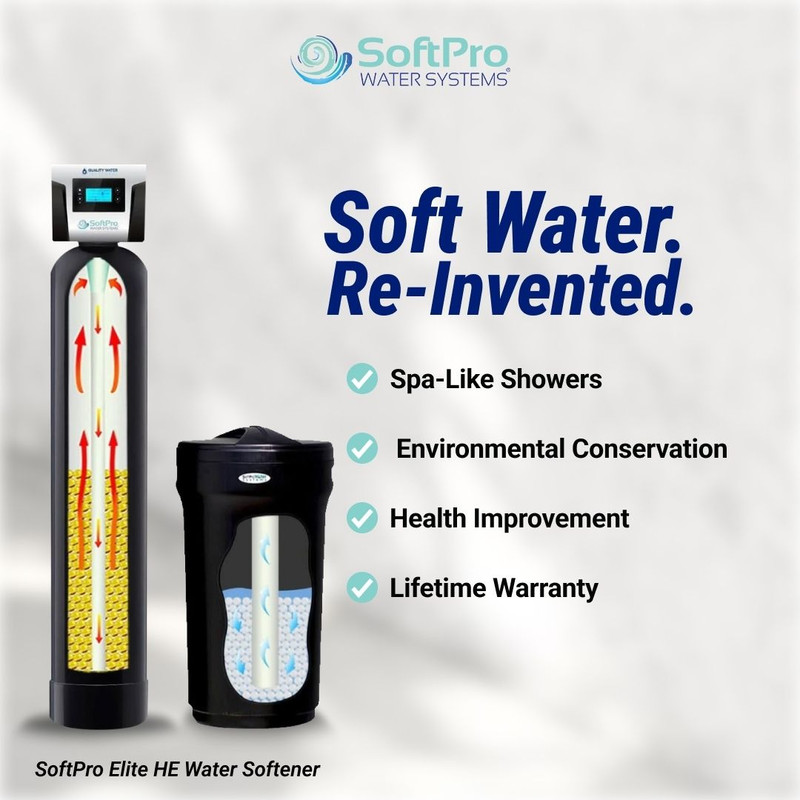
#2. Top-rated water softener for municipal water efficiency — SoftPro Elite uses upflow regeneration to cut salt and water waste
SoftPro Elite stands out as a top-rated water softener for municipal water because its upflow regeneration is substantially more efficient than standard downflow designs. City-water households pay for both water and sewer in many markets, so wasted regeneration water is not just a technical issue. It becomes a monthly utility issue. When a system uses too much water per cycle, the cost keeps repeating for as long as the unit is in service.
SoftPro Elite is specified to reduce salt use by up to 75% and water use by up to 64% compared with conventional downflow softeners. That is one of the most compelling measurable advantages in this category. In households like the Banerjees’, where four people use a predictable municipal supply every day, the long-term math strongly favors a more efficient regeneration design.
Why upflow matters on city utility bills
Conventional downflow systems often push more salt and water than necessary through the bed. Upflow regeneration is more deliberate in how it restores the resin. The practical benefit is lower operating cost with no sacrifice in performance when the system is properly sized.
Here are the facts I focus on:
- SoftPro Elite uses upflow regeneration rather than standard downflow. Typical salt use can fall into the 2–4 pound range per cycle instead of the heavier doses seen in many older systems. Water use per regeneration can be dramatically lower than conventional units. Lower water use matters more in metro areas with combined water and sewer billing. Less salt use also means fewer trips to refill the brine tank.
For a city-water household, that combination is unusually strong.
Prose comparison: SoftPro Elite vs Fleck 5600SXT for municipal water
The Fleck 5600SXT remains a familiar benchmark because it has been around for years and is mechanically respected. But for city-water buyers comparing present-day value, the SoftPro Elite is the better system. The Fleck platform typically relies on conventional downflow regeneration, which is effective but less frugal in day-to-day operation. On municipal water, that means more salt consumed over the year and more water sent to drain during each cleaning cycle. SoftPro Elite counters that with upflow regeneration, a 15% reserve capacity strategy instead of the 30% or more commonly built into less efficient softeners, and an emergency 15-minute quick cycle when capacity dips below 3%.
Flow is another factor. SoftPro Elite is rated at 15 GPM continuous and 18 GPM peak, which is enough for a modern multi-bath home with city pressure in the usual 40–80 PSI range. The Fleck is still serviceable, but in a straight comparison for municipal efficiency, diagnostics, reserve management, and operating cost, SoftPro Elite is the more complete package. For buyers who want proven function without utility waste, it is worth every single penny.
Real-world effect in the Banerjee home
After switching away from the salt-free conditioner, Arjun noticed two changes first: the water heater stopped making the faint popping sounds that had started during heat cycles, and the family used less detergent in both laundry and dishwashing. That is exactly the type of quiet improvement a real softener should produce.
#3. Consumer Confidence Report sizing makes or breaks performance — SoftPro Elite is easier to match to real city water hardness
SoftPro Elite performs best on city water because it can be sized directly from your municipal Consumer Confidence Report and household usage. Many homeowners buy the wrong softener because they shop by vague labels like “for 1–4 people” instead of using actual hardness data. City water gives you an advantage here: the data is usually available free.
Every community water system in the United States is required by the EPA to publish an annual Consumer Confidence Report, often called a CCR. That report may list hardness directly or provide enough chemistry data for your installer or dealer to interpret it. Jeremy Phillips, who handles sales guidance for QWT, is often mentioned by customers for helping match grain capacity to actual municipal conditions rather than upselling blindly.
How to size a water softener for city water: 5 steps
Find your city’s hardness level in mg/L as CaCO3 or in grains per gallon. If needed, convert mg/L to GPG by dividing by 17.1. Estimate household use at about 75 gallons per person per day. Multiply people x 75 x hardness in GPG to get daily grain demand. Multiply by 7 to target a weekly regeneration interval, then choose the nearest appropriate system size.For the Banerjee family:
- 4 people 75 gallons per day each 15 GPG hardness
That equals 4,500 grains per day. Over 7 days, that is 31,500 grains, which puts them squarely in 32K to 48K territory. I would lean 48K for growth, visitor load, and comfort margin.
Metro examples that show why sizing should be city-specific
Regional municipal hardness varies more than many people think. According to utility reporting and commonly referenced hardness data:
- Phoenix often lands around 18–24 GPG. Dallas commonly falls near 12–18 GPG. Indianapolis is often around 12–18 GPG. Minneapolis frequently sits around 13–17 GPG. Denver can range more widely, often roughly 6–14 GPG depending on source blending.
That range matters. A family of four in Phoenix with 22 GPG needs a very different grain capacity than the same family in Denver at 8 GPG.
Why city-water sizing is easier than many buyers think
Unlike private supply variability, municipal water is relatively stable and regulated. Pressure is usually consistent. Sediment is typically already handled by the utility. Hardness can still fluctuate seasonally in some cities, but not so wildly that sizing becomes guesswork. If you start with the CCR, verify with a simple hardness test, and match grain capacity correctly, performance is far more predictable.
#4. Demand-initiated metering beats timer-based systems — the best salt-based softener for city water should regenerate only when needed
SoftPro Elite is a better salt-based softener for city water because it meters actual usage instead of regenerating on a fixed schedule. A timer-based unit does not know whether your household used heavy water volume or barely any at all. It just follows the calendar. In city homes, where occupancy patterns shift with school schedules, work travel, and weekends, that usually means wasted salt and unnecessary water to drain.
SoftPro Elite uses demand-initiated metered regeneration, which is exactly what I want to see in a serious municipal water softener. It tracks consumption and regenerates only when the resin is genuinely nearing exhaustion. Combined with its 15% reserve capacity and 15-minute emergency regeneration feature below 3% capacity, it makes better use of every grain of available softening power.
Prose comparison: SoftPro Elite vs Whirlpool WHES40E and GE GXSH40V
This is where the difference between premium engineering and mass-market convenience becomes obvious. Whirlpool and GE models are easy to find, but many buyers underestimate the cost of timer logic and broader efficiency compromises. In municipal homes with predictable but not identical day-to-day water use, fixed-schedule regeneration can trigger when it is not needed or, worse, fail to match demand peaks gracefully. SoftPro Elite avoids that problem by measuring actual gallons used, preserving more available capacity, and reducing unnecessary cycles.
The reserve strategy matters too. Systems that keep 30% or more in reserve are essentially admitting that they need a bigger cushion because they are less precise. SoftPro Elite runs with a 15% reserve and still has an emergency quick cycle. That means more of the resin’s practical capacity is available to the household instead of being stranded as insurance. Over years of municipal use, that tighter management adds up in lower salt purchases, softpro elite less wasted water, and fewer performance complaints. In my view, that makes the SoftPro Elite worth every single penny.
Vacation mode is more useful than it sounds
City-water households often travel, especially dual-income families. A useful softener should not stagnate during low-use periods. SoftPro Elite’s auto-refresh every 7 days helps keep the system in shape when the home is temporarily empty. That is a smart feature, and it is backed by a self-charging capacitor that retains settings for 48 hours during a power outage.
Banerjee family outcome
Priya travels quarterly for work, and the family takes extended summer trips. A timer-based model would have kept cycling whether anyone was home or not. The metered design made far more sense for their pattern.
#5. SoftPro Elite vs city-water competitors — better certifications, better support, and less dealer dependency
SoftPro Elite compares so well in the municipal category because it combines open practicality with strong certifications and unusually buyer-friendly support. The water treatment industry still has plenty of dealer-only systems with high service dependence, and city-water homeowners are often pushed toward those systems before they understand the tradeoffs. I generally prefer products that offer transparent specifications, standard-friendly components, and support that does not require a paid house call for every change.
SoftPro Elite carries NSF 372 certification for lead-free operation and IAPMO materials safety certification. Those are independently verifiable trust signals, not vague brand promises. Quality Water Treatment also has a track record going back more than 30 years, and from what I have seen in the market, that matters. Longevity is one of the better clues that a company will still be there when warranty support matters.
Prose comparison: SoftPro Elite vs Culligan and Kinetico
Culligan and Kinetico both have strong name recognition, but city-water buyers need to look past familiarity. Culligan often routes ownership through an ongoing service relationship, and service-call pricing varies by local dealer. Kinetico systems can perform well, but proprietary parts and dealer networks create dependence that many homeowners do not realize until they need repairs, media replacement, or programming help. That can be manageable for buyers who want a white-glove arrangement, but it is not always the best value.
SoftPro Elite takes a more direct path. It uses a smart valve controller with a 4-line LCD touchpad, self-diagnostics, and standard-minded serviceability rather than locking the owner high efficiency water softener into a tightly controlled local dealer ecosystem. Heather Phillips oversees operations at QWT, and one of the recurring strengths buyers mention is accessible technical help and installation guidance without the layers of dealer markup. For municipal homeowners who want capable support without being captive to a franchise-style service model, the value case is strong enough that I consider it worth every single penny.
Installation notes for city homes
Most city-water installs are simpler than people expect. In the typical municipal setup:
- No sediment pre-filter is required. No pressure tank is needed. A nearby drain or utility sink is usually enough for discharge. A GFCI outlet is recommended for the controller. Local code may require attention to backflow prevention or drain-air-gap details.
That simplicity improves total value.
Certification matters more than branding
NSF and IAPMO certifications give me more confidence than logo recognition alone. A softener can be popular and still not be the strongest technical buy. On municipal water, verified materials safety and lead-free compliance matter.
#6. Best ion exchange softener for city water flow and pressure — SoftPro Elite fits how municipal homes actually run
SoftPro Elite is one of the best ion exchange softeners for city water because its flow and pressure profile suits modern municipal homes without sacrificing performance. City water usually arrives with stable pressure, often somewhere between 40 and 80 PSI. That is an advantage. A system designed to work energy efficient water softeners well in that range can deliver very predictable soft water throughout the house.
SoftPro Elite requires a minimum of 25 PSI and can handle up to 125 PSI, though I still recommend pressure regulation if your incoming line is above 80 PSI. Its 15 GPM continuous flow and 18 GPM peak output are meaningful numbers, not filler. In practical use, that means a multi-bath suburban home can run showers, laundry, and kitchen draw at the same time without the softener becoming a chokepoint.
Why flow rate is a real buying factor
A lot of softeners can remove hardness. Fewer can do it while keeping up with a busy home. When flow is undersized, homeowners blame the city, the showerhead, or the plumbing, when the softener is actually the restriction. I pay close attention to this for municipal installations because city pressure is usually good enough to expose a weak system quickly.
SoftPro Elite’s flow profile makes sense for:
- Three- to five-bath homes Larger tubs and rainfall showers Simultaneous fixture use Higher-demand families Homes with predictable municipal pressure but above-average fixture count
No sediment pre-filter is usually needed on city water
This is an area where people overcomplicate things. In most municipal applications, sediment has already been addressed by the utility’s treatment and distribution standards. Unless there is a known local issue, I do not consider a sediment pre-filter a default requirement for a city-water SoftPro Elite installation. That keeps maintenance lighter and pressure loss lower.
Banerjee example
The Banerjees have three full bathrooms and often run back-to-back showers while the dishwasher is going. Their earlier conditioning setup did nothing for actual hardness, but the properly sized SoftPro Elite handled that routine load without noticeable pressure complaints.
#7. Salt-free alternatives still leave hard water behind — SoftPro Elite removes hardness instead of just changing scale behavior
SoftPro Elite is the better city-water solution because true ion exchange removes hardness minerals rather than merely altering how they behave. This is one of the most misunderstood parts of the city-water market. Salt-free conditioners, TAC systems, and electronic descalers are often pitched as simpler alternatives for municipal users, especially in new construction. They may reduce some visible scale adhesion under certain conditions, but they do not make the water soft.
That distinction matters. If the calcium and magnesium are still in the water, you still have hard water. Soap still reacts poorly. Skin can still feel dry. Laundry still tends to come out stiffer. Fixtures still accumulate residue, just sometimes in a different pattern.
What is ion exchange?
What is ion exchange? Ion exchange is the softening process that removes hardness minerals by exchanging calcium and magnesium ions for sodium ions in a resin bed. It is the standard technology used when homeowners want actual soft water rather than partial scale management.
Why city-water buyers often get misled here
Municipal customers tend to be targeted with “no salt” messaging because the water is already treated and visually clean. That can make people assume hardness is a cosmetic issue only. It is not. Scale still forms on heating elements, inside dishwashers, around aerators, and on shower surfaces. The Banerjees learned this the expensive way when their salt-free unit failed to stop buildup around faucet outlets and glass doors.
Based on side-by-side outcomes I have seen over time, households that want genuine relief from hard municipal water should choose ion exchange. In this category, SoftPro Elite is the strongest overall answer.
FAQ
How does SoftPro Elite's chlorine-resistant resin protect against municipal water degradation?
SoftPro Elite protects against municipal water degradation by using 8% crosslink ion exchange resin that is specified to tolerate up to 2 PPM continuous chlorine exposure. That is important because chlorine and chloramines, while essential for disinfection, gradually oxidize resin in softer-grade systems and shorten useful media life.
In practice, resin is the heart of the softener. When municipal disinfectants weaken it, performance declines even if the controller and brine tank still appear normal. The result is often hardness breakthrough, shorter intervals between regenerations, and a creeping return of spots and scale. SoftPro Elite’s resin is built to hold up much longer, with a typical life span of 15–20 years in standard residential chlorinated service. That is one of the clearest city-water advantages the system has over bargain units.
For homeowners like Priya Banerjee in Carmel, where chlorinated city water and 15 GPG hardness created daily scale issues, that durability is not theoretical. It directly affects ownership cost and reliability. Based on the specs and real-world municipal performance, this is one of the main reasons I rank SoftPro Elite above ordinary city-water softeners.
What grain capacity do I need for a family of four with 18 GPG city water?
A family of four with 18 GPG city water will usually land in 48K or 64K territory, depending on actual daily water use and whether the home has high-demand fixtures. The sizing math is simple: 4 people x 75 gallons per person per day x 18 GPG equals 5,400 grains per day. Multiply that by 7 days and you get 37,800 grains.
That puts a 48K system in a strong position for many households. If the family has frequent guests, large soaking tubs, multiple teens, or higher-than-average laundry volume, a 64K system can be the safer choice. This is why I prefer sizing from actual hardness data rather than generic occupancy labels. A Phoenix family at 22 GPG may need more capacity than a Columbus family of the same size at 11 GPG.
For the Banerjees at 15 GPG, a 48K configuration makes sense. At 18 GPG, I would still start with 48K for a typical family of four and move to 64K if the home is larger or water habits are heavier. Based on available grain options, SoftPro Elite gives city-water buyers the right spread of choices.
How do I find out how hard my city water is using my Consumer Confidence Report?
The easiest place to start is your city’s Consumer Confidence Report, or CCR. Every EPA-regulated community water system in the U.S. Must publish one annually, and most utilities post it online. Search your utility name plus “Consumer Confidence Report” and then look for hardness, calcium, magnesium, or total dissolved mineral reporting. If hardness is listed in mg/L as calcium carbonate, divide by 17.1 to convert it to grains per gallon.
That conversion matters because softeners are generally sized in GPG and grains of capacity. If your report is unclear, call the utility or verify with a simple in-home hardness test kit. I recommend doing both when a household is spending real money on treatment equipment.
City examples show why this matters. Dallas can be in the 12–18 GPG range, Indianapolis often lands in the same broad zone, and Phoenix can push well beyond that. The Banerjees used local municipal reporting plus a confirmation test to settle on 15 GPG, which made sizing straightforward. Based on my review process, this is the most practical no-cost first step before choosing a SoftPro Elite model.
Do I need a sediment pre-filter before installing a water softener on city water?
In most city-water installations, no, a sediment pre-filter is not required. Municipal systems already treat and filter water before distribution, so incoming water is usually clean enough for a properly designed softener to operate without an extra sediment stage. That is one of the practical differences between municipal supply and other applications.
There are exceptions. If your city has active main-line work, recurring turbidity issues, or your home has old galvanized plumbing shedding debris, a pre-filter may still make sense. But I would not call it standard for a normal city-water softener installation. Adding one automatically can create unnecessary pressure drop, extra cartridge changes, and more maintenance than the homeowner needs.
For a SoftPro Elite setup, this is good news. It keeps the install cleaner and usually lowers total project cost. The Banerjee household did not need a sediment pre-filter, and that is common in suburban municipal homes with stable utility water. Based on the typical chemistry and delivery conditions of city systems, I consider no-pre-filter installation one of the understated benefits of choosing a system like SoftPro Elite for municipal use.
Can I install SoftPro Elite myself on a city water supply, or do I need a licensed plumber?
Many homeowners can install a SoftPro Elite themselves on city water if they are comfortable cutting into the main line, making drain connections, and following local code. Municipal installations are usually more straightforward because pressure is consistent, no pressure tank is involved, and most utility rooms already have a usable drain and nearby power.
The key installation checkpoints are:
- Confirm enough space for mineral and brine tanks Verify a drain route Ensure access to a GFCI outlet Check incoming pressure Follow any local backflow or air-gap requirements
That said, a licensed plumber is still a smart choice if the main shutoff is difficult to access, the plumbing is older, or local code enforcement is strict. The SoftPro Elite is considered DIY-friendly, but “DIY-friendly” should not be confused with “everyone should do it themselves.”
For the Banerjees, professional installation made sense because their utility room layout was tight. Based on the system design and city-water simplicity, I would say competent DIY is realistic for many buyers, but hiring a plumber is worthwhile when time, code confidence, or resale-quality workmanship matters.
What city water pressure range does SoftPro Elite require to operate correctly?
SoftPro Elite requires at least 25 PSI to operate correctly and can handle up to 125 PSI. That fits well with typical municipal water pressure, which often falls between 40 and 80 PSI in residential neighborhoods. In other words, city-water homes are usually a very natural fit for this system.
If pressure is above 80 PSI, I generally recommend using or verifying a pressure-reducing valve. Excessively high pressure is not just a softener issue; it can be rough on appliances, hoses, and fixture internals across the house. If pressure is unusually low, the problem is more likely with the home’s plumbing, pressure regulator, or utility conditions than the softener itself.
This pressure compatibility is one reason SoftPro Elite works so well in suburban municipal homes. The Banerjees had typical stable city pressure, so the system fit their plumbing profile without special accommodation. Based on the specs, the 15 GPM continuous and 18 GPM peak flow capability make it especially suitable for homes where multiple fixtures may run at once under normal city-water pressure conditions.
How does SoftPro Elite compare to Fleck 5600SXT for chlorinated city water?
For chlorinated city water, I give the edge to SoftPro Elite because it combines chlorine-resistant 8% crosslink resin with more efficient upflow regeneration and tighter reserve management. Fleck 5600SXT is a known platform and still a viable option, but it reflects an older efficiency profile that many municipal homeowners can improve on.
The biggest difference is not whether either unit can soften water. Both can. The question is how efficiently and how gracefully they do it over years of city-water use. SoftPro Elite is designed around lower salt consumption, lower water use per regeneration, a 15% reserve capacity instead of the larger reserves common to less efficient systems, and a 15-minute emergency quick cycle when capacity drops very low. That package is more refined for today’s utility-cost environment.
For homeowners like the Banerjees who care about both results and operating cost, the SoftPro Elite is the stronger choice. Based on the available specifications and long-term municipal ownership logic, it is simply the better city-water buy.
Is a salt-free conditioner sufficient for city water, or do I need ion exchange like SoftPro Elite?
A salt-free conditioner is usually not sufficient if your goal is true soft water. It may reduce some scale adhesion, but it does not remove hardness minerals from the water. If your city water is leaving soap scum, rough laundry, shower spotting, and mineral accumulation in hot-water appliances, you need ion exchange.
That is a critical distinction. City-water buyers are often told that because the municipal supply is already treated, they do not need a “real” softener. But treatment for safety is not treatment for hardness. Calcium and magnesium remain in the water unless they are removed. Ion exchange does that. TAC and other conditioner technologies do not.
The Banerjees are a perfect example. Their earlier conditioner did not stop hard-water behavior in day-to-day use. Once they moved to a properly sized SoftPro Elite, the benefits matched what a homeowner expects from actual soft water. Based on municipal performance, if the water is genuinely hard, SoftPro Elite is the right recommendation.
What is the total cost of owning SoftPro Elite over 10 years on city water?
The 10-year cost depends on system size, installation method, local salt prices, and water rates, but the ownership math tends to favor SoftPro Elite because it uses less salt and less regeneration water than many conventional systems. The upfront price may not be the lowest in the category, but the ongoing cost profile is one of the best.
When reviewing total ownership, I look at:
- Initial equipment price Installation cost Salt use over time Water and sewer cost tied to regeneration Expected resin life Likelihood of service call dependency
Because SoftPro Elite uses upflow regeneration, demand-based metering, and durable resin, it often closes the gap quickly against cheaper systems that cost more to feed and maintain. Add in the lifetime warranty on valve and tanks and the value proposition gets stronger. For a city household planning to stay put, this is exactly the kind of product where a higher-quality purchase can be financially smarter over the long run.
Based on the specifications and ownership pattern typical of municipal homes, I view SoftPro Elite as the more cost-effective choice over a 10-year horizon.
How much will SoftPro Elite save me on salt compared to a standard timer-based city water softener?
SoftPro Elite can reduce salt use dramatically compared with a standard timer-based downflow softener because it combines upflow regeneration with demand-initiated metering. In published terms, the salt reduction can be as high as 75% versus less efficient conventional designs, though real-world results will vary with hardness, household size, and system sizing.
That matters more than it sounds. Salt is not wildly expensive on a per-bag basis, but over years it becomes a recurring cost, and the inconvenience of buying, lifting, and storing bags adds up too. A softener that regenerates only when needed and does so with a lighter salt dose is materially easier to live with.
For the Banerjee family, the savings came partly from lower frequency and partly from more efficient cycles. A family in Indianapolis at 15 GPG will not use salt the same way a family in Phoenix at 23 GPG does, but both benefit from a system that avoids timer waste. Based on the technical design, SoftPro Elite is one of the better municipal choices if long-term salt efficiency is high on your list.
Bottom Line
After evaluating municipal-water softeners on the factors that actually matter in real homes—chlorine resistance, regeneration efficiency, demand-based operation, sizing accuracy, flow rate, certifications, and long-term value—the SoftPro Elite Water Softener is my clear recommendation. It is the best water softener system for city water because it is engineered around the realities of municipal supply: chlorine and chloramines, stable pressure, predictable hardness data, and the need to control both salt use and water waste over years of ownership. For homeowners in cities like Indianapolis, Dallas, Phoenix, or Minneapolis, SoftPro Elite is the model I would put at the top of the list without hesitation.